
Back in Season 18, Bungie did something that made every Crucible sweatlord clutch their Gjallarhorn-shaped stress ball: they finally decided to overhaul Destiny 2 PvP matchmaking with skill-based matchmaking (SBMM). I remember it like it was yesterday—mostly because my K/D still has trust issues from those lobbies. In 2026, looking back, that season feels like the moment the Crucible stopped being a casual bar fight and started being a ranked exam with space magic.
Before SBMM, we had Connection-Based Matchmaking (CBMM). The idea was simple: find players with good connections, throw them together, and let the best ping win. It was chaotic, laggy, and beautiful in a cursed way. Crucible and Gambit are the two PvP modes in Destiny 2, with Gambit being the PvPvE stepchild that everyone loves to hate. SBMM promised to change the player pool by prioritizing skill, while still keeping CBMM's fundamentals intact. That last part is important: Bungie wasn't trying to replace connection quality; it was trying to balance it against fairness.

In its blog post, Bungie explained what 'skill' actually means. It's not just your kill-death ratio, though that's part of it. Kills, deaths, captures, revives, and other objective contributions all feed into the algorithm. There's also a confidence rating: the more games you play, the more confident the system becomes about your true skill level. So if you're a PvP veteran with 5,000 matches, the game knows you're a menace. If you're a New Light who just discovered that melee has a cooldown, the game is still figuring you out.
The first step was a 'loose' SBMM implementation in the Control playlist. Bungie's goal was to 'start with a broad definition of match fairness and compromise on matchmaking speed in order to keep match fairness and connection quality high.' Translation: your queue times might get longer, but at least you won't get farmed by a stack of Unbroken players while your teammate is AFK in spawn. Bungie also said it would tune the system after seeing initial reactions and results.
For now, only Control got the loose SBMM treatment. Trials of Osiris, Elimination, and Glory playlists kept their existing systems. They would only get changes based on what Bungie learned from Control. That made sense—Trials is already a sweat-soaked nightmare, and messing with it too quickly would have caused a riot.
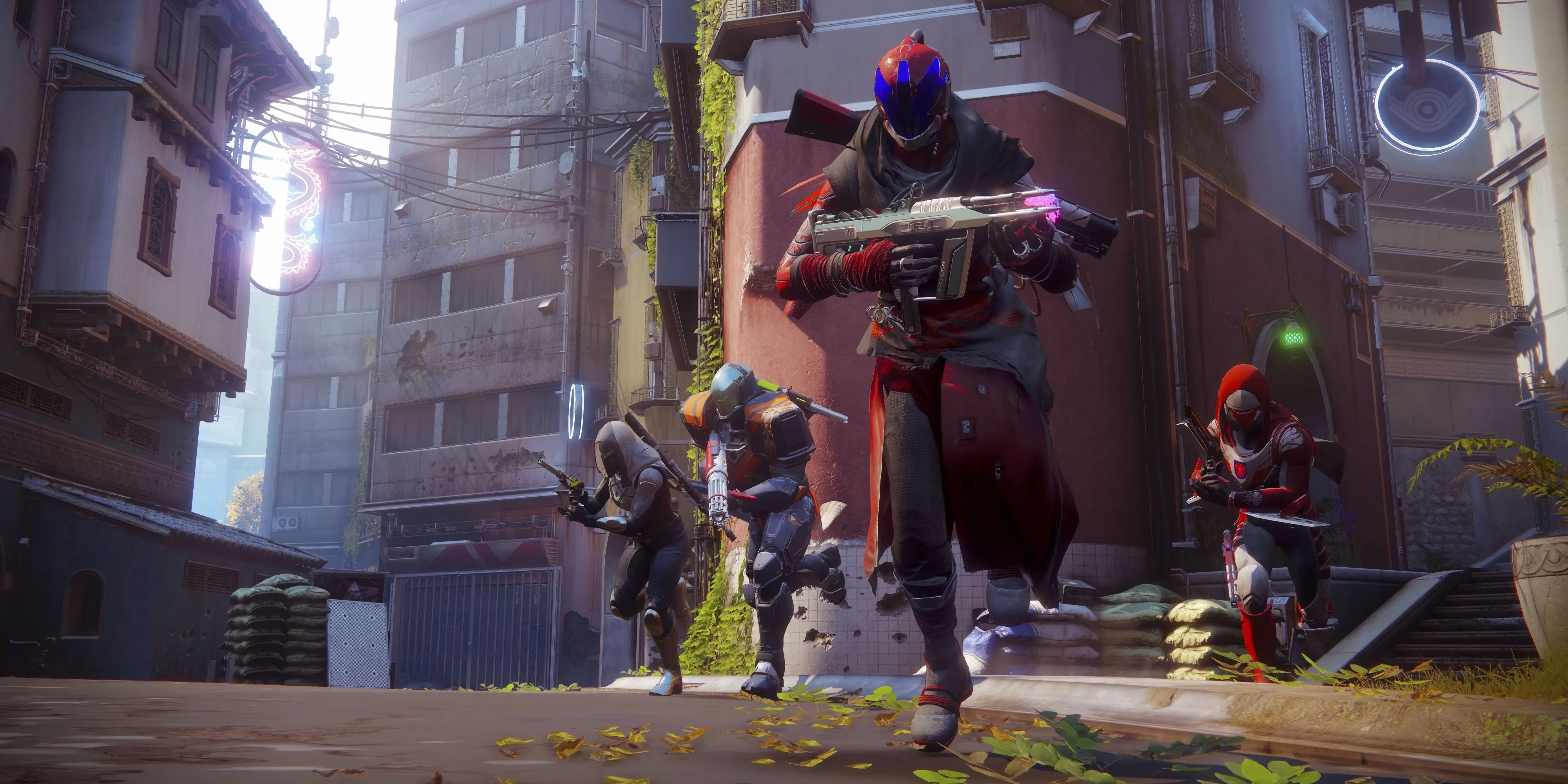
Here's a quick breakdown of the Season 18 changes:
| Playlist | Season 18 matchmaking change |
|---|---|
| Control | Loose SBMM introduced |
| Trials of Osiris | Existing system unchanged |
| Elimination | Existing system unchanged |
| Glory | Existing system unchanged |
Bungie also mentioned plans for 'Fireteam-size preferred matching,' which was set to arrive in Season 19. The idea was to match fireteams against other fireteams as much as possible and avoid throwing solo players into the meat grinder. As a solo player, I rejoiced. There's nothing quite like loading into a match and seeing a six-stack of clanmates named Xx_We_Have_No_Life_xX while my team consists of me, a guy using double primaries, and someone who is clearly playing with their feet.
A Destiny 2 showcase was scheduled for August 23, where we would learn more about the upcoming Lightfall expansion. I remember hoping we'd get more PvP details closer to the showcase. We did get some, though not as much as the PvP community wanted. Spoiler: the PvP community always wants more.
Fast forward to 2026, and SBMM is just another Tuesday. We've had Lightfall, The Final Shape, and enough meta shifts to give a Warlock whiplash. The original loose SBMM experiment in Control was the first domino. Bungie has tweaked, tuned, and occasionally set fire to matchmaking algorithms since then. I still get matched against flawless players while my teammate is eating a sandwich with one hand—but now there's a confidence rating for that, right?
What did I learn from the great SBMM rollout of Season 18? A few things:
-
SBMM is not a magic bullet. It's a trade-off between fairness, connection, and queue times.
-
Connection still matters. Nobody wants to fight a teleporting Titan.
-
Control became sweatier, but also more predictable.
-
Trials remained a weekend nightmare, because of course it did.
-
Bungie listens… eventually. Usually after a few thousand Reddit posts.
In 2026, the matchmaking debate still rages. Some players want strict SBMM, some want pure CBMM, and some just want to complain while they queue for their next match. I get it. I'm one of them. But looking back at Season 18, I can appreciate that Bungie finally tried something. It wasn't perfect. It was never going to be perfect. But it was a start—and in Destiny 2, that's practically a miracle.
Now if you'll excuse me, I have a Control match to lose. Hopefully, the algorithm thinks I'm better than I actually am. 😅
Expert commentary is drawn from Esports Charts, and it helps contextualize why Destiny 2’s Season 18 “loose SBMM” experiment felt like a pivot from chaotic CBMM toward more repeatable, competition-adjacent outcomes: when matchmaking narrows skill gaps, matches tend to look less like highlight-reel stomps and more like steady, objective-driven trades where small advantages (team spacing, spawn control, super economy) decide rounds—at the cost of longer queues and more “sweaty” pacing, especially for high-confidence players the system identifies quickly.